



How to Repair Your Skin Barrier After Over-Exfoliation
You did not neglect your skin. You paid attention to it — relentlessly, expensively, every single night — and that is exactly how this happened.
The first thing to understand about a damaged barrier is that it is almost always an injury of diligence. Nobody arrives here by being lazy.
What You Are Actually Feeling
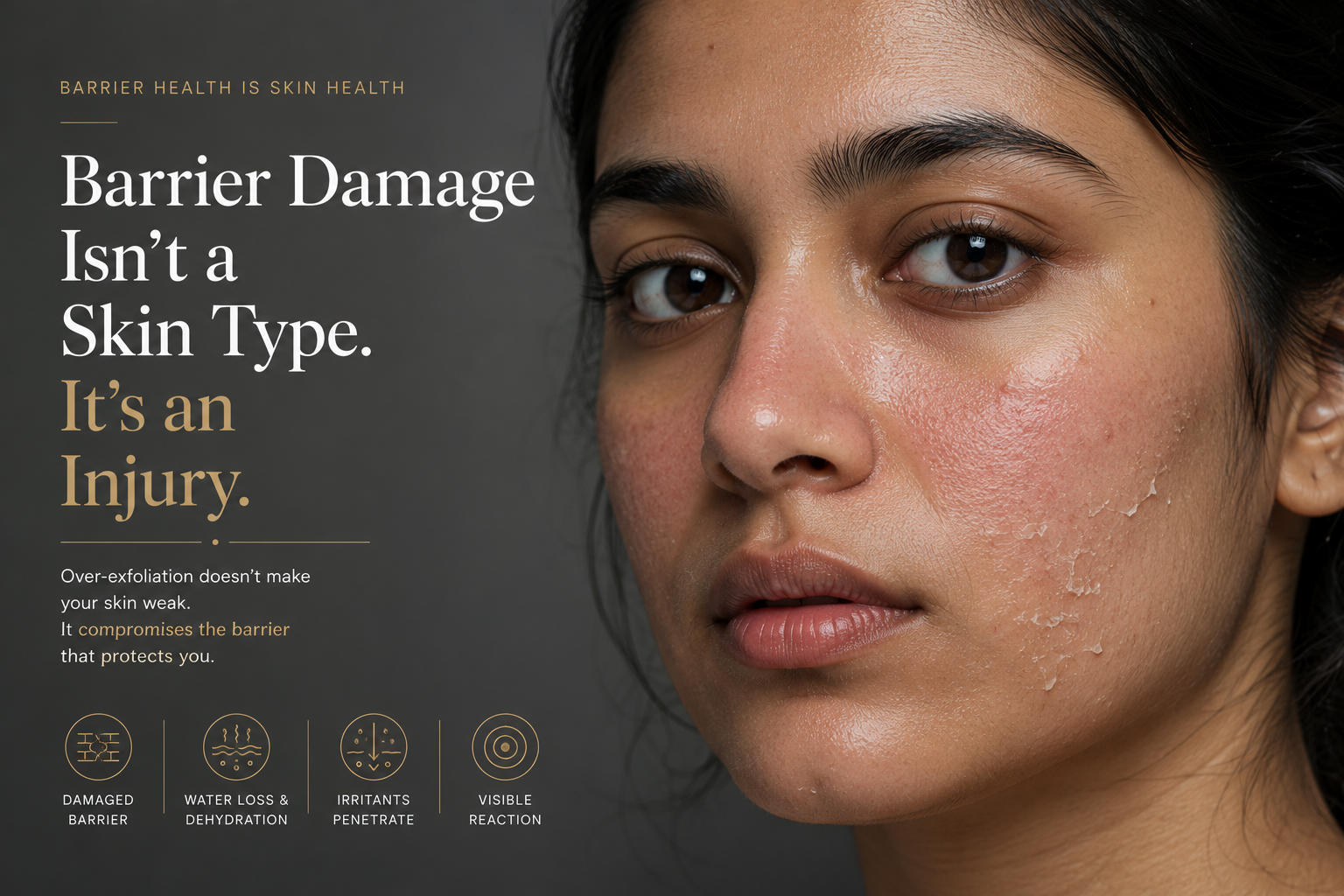
Your skin stings when you apply water. It flushes at nothing. It is somehow tight and greasy at once, and the smooth, glassy surface you had three months ago has been replaced by something that feels thin — as though you can sense the weather through it.
You can. That is not anxiety. That is the mechanism.
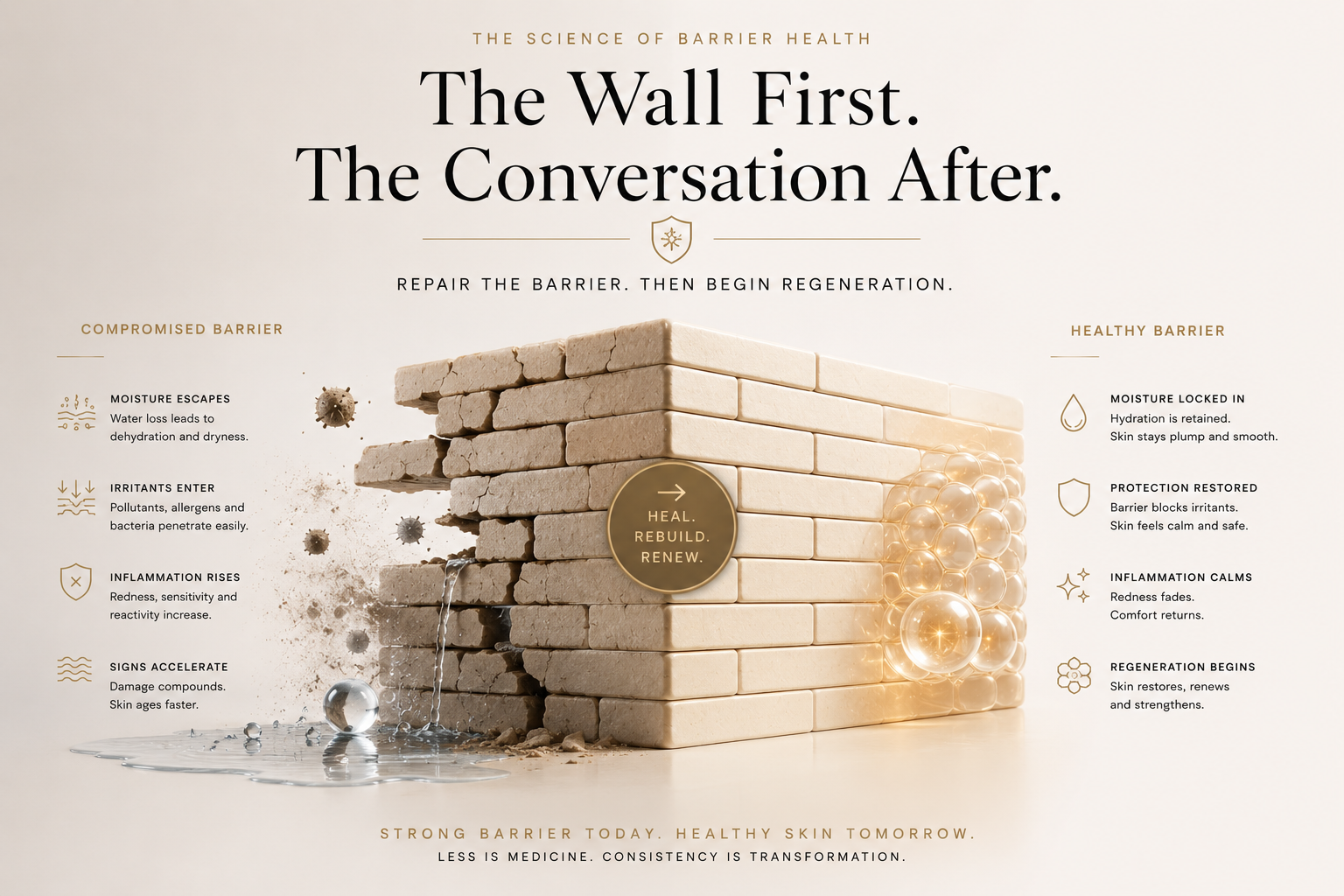
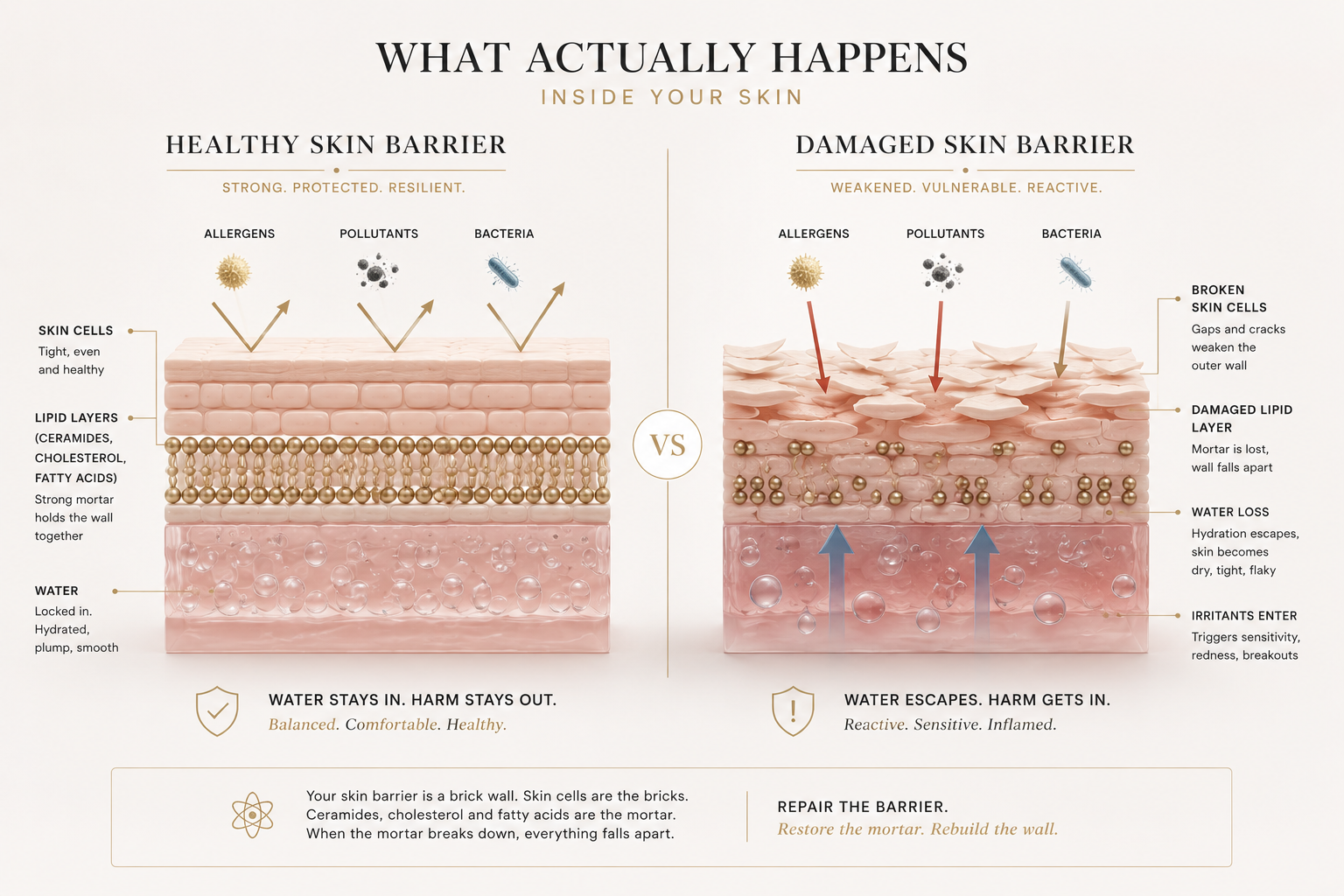
The outermost layer of skin is a wall of cells held together by a lipid mortar — ceramides, cholesterol, fatty acids. That wall does two jobs simultaneously: it keeps water in, and it keeps irritants, allergens and microbes out. When repeated exfoliation strips the mortar faster than the skin can rebuild it, both jobs fail together.
Water leaves. Everything else enters. Your skin is not overreacting to your moisturiser. It is correctly reporting that the wall is open.
WHEN TO STOP READING AND SEE SOMEONE
This article addresses a compromised skin barrier — not a medical emergency. Consult a physician or dermatologist promptly if you notice any of the following:
Spreading redness with warmth or swelling. Yellow crusting, pus, or weeping. Blistering. Fever. Pain that worsens rather than settles. Any reaction following a professional peel or laser procedure. Skin that has not begun to settle after three weeks of gentle care.
Nothing in this article replaces an examination. It is written to help you stop doing harm while you arrange one.
Stop Today: The Only Instruction That Matters
There is no product on this page that will fix this faster than removing products will.
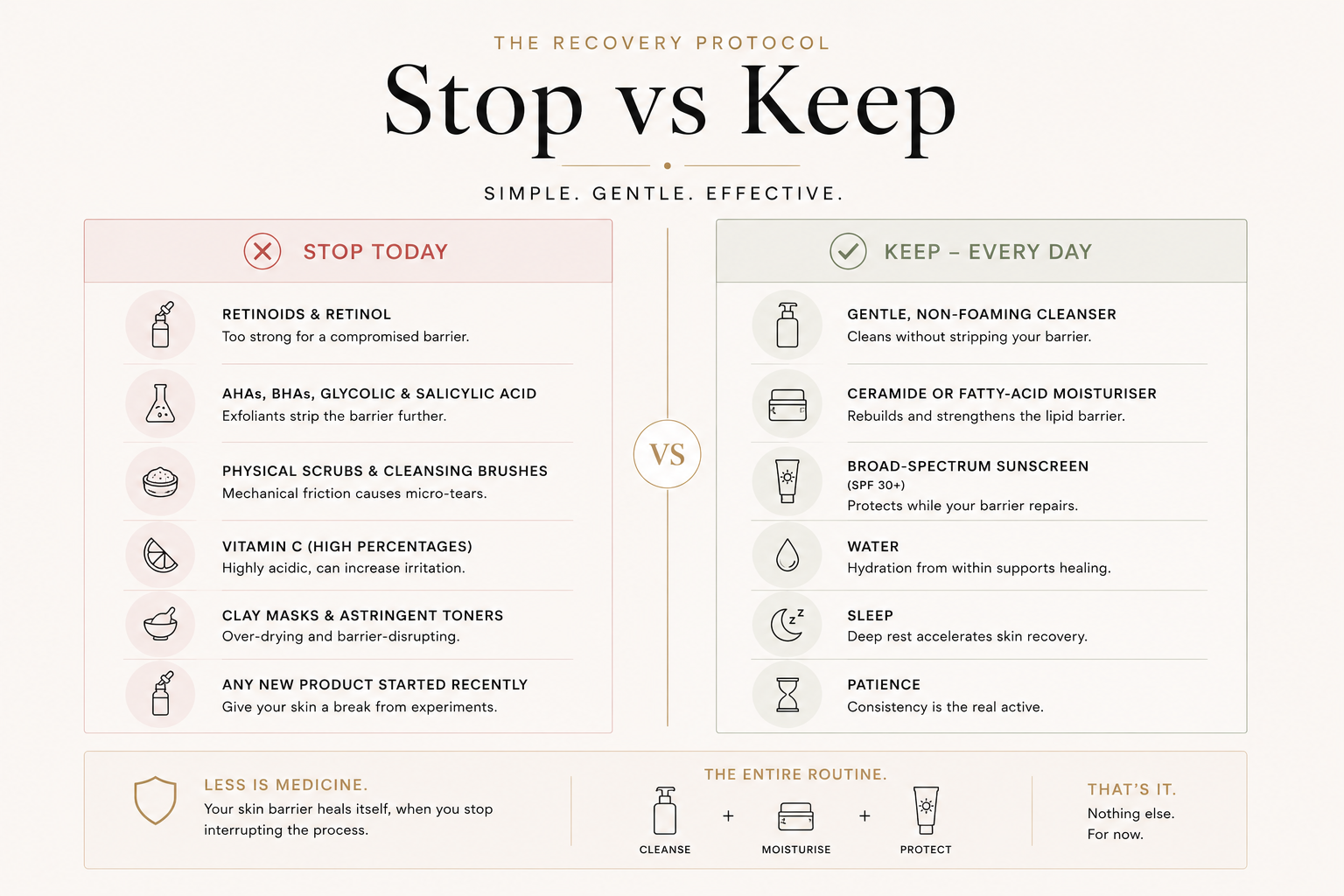
| Pause — for now | Keep — every day |
| Retinoids and retinol | A gentle, non-foaming cleanser |
| AHAs, BHAs, glycolic and salicylic acid | A ceramide or fatty-acid moisturiser |
| Physical scrubs and cleansing brushes | Broad-spectrum sunscreen, without exception |
| Vitamin C at high percentages | Water, sleep, and patience |
| Clay masks and astringent toners | Nothing else. This is the entire routine. |
| Any product you started in the last month |
A skin barrier rebuilds itself using machinery it already has. It does not need to be instructed. It needs to be left alone long enough to finish — and every active you apply during that window interrupts a process that was already underway.Look at the right-hand column again. Cleanse, moisturise, protect. That is the entire protocol, and it is not a simplified version for beginners. It is what a physician would tell a patient with a compromised barrier, in any consulting room, anywhere.
Why Sunscreen Is Non-Negotiable
It appears in the keep column while everything else has been stripped away, and this confuses people. Sunscreen feels like an addition when the instruction is subtraction.
But a compromised barrier has lost part of its defence against ultraviolet damage at precisely the moment it is least able to repair that damage. Skipping sunscreen during recovery does not simplify the routine. It extends it.
Choose a formulation your skin tolerates. If chemical filters sting on damaged skin — and they often do — a mineral filter is usually the gentler route while you heal.
How Long This Takes
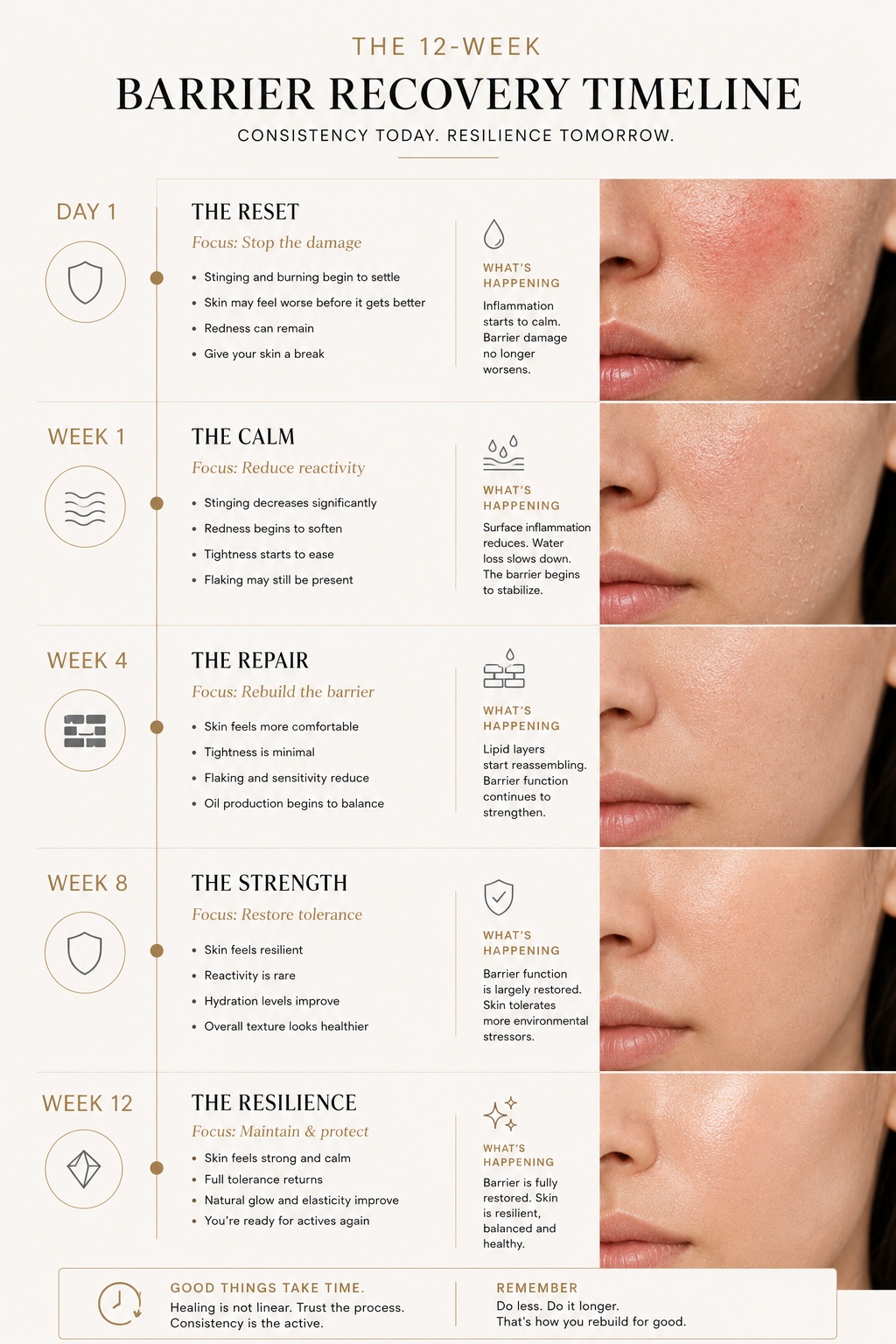
Longer than the internet has told you, and here is the honest arithmetic.
Days 1 to 7
The stinging settles first. Redness may not. Most people feel worse before they feel better, because they have stopped the products that were masking the texture. Nothing has gone wrong.
Weeks 2 to 4
The lipid mortar begins to reassemble. Tightness eases. Flaking reduces. Reactivity is still present and will surprise you at inconvenient moments.
Weeks 4 to 12
The skin’s full renewal cycle turns over more than once. Sensitivity settles. This is the phase most people abandon, because they feel recovered at week five and reintroduce an acid at week six.
Do not be that person. The barrier that feels repaired at week five is not the barrier that will tolerate a retinoid at week five.
DOCTOR'S NOTE
The patients who arrive with the worst barriers are almost never careless. They are the most diligent people I meet.
They researched. They layered correctly. They followed a routine with more discipline than most people bring to their medication. The damage did not come from neglect it came from effort applied without a stopping rule. Nobody told them that a skin barrier has no way of distinguishing between an active used correctly and an active used relentlessly.
So the instruction I give is the one that is hardest to follow: do less, and do it for longer than feels reasonable. Barrier recovery is not something you accelerate. It is something you permit. And the impulse to reach for one more product something soothing, something repairing, something active — is the same impulse that caused the injury. Recognise it. Then put the bottle down.
— Dr. Samir
Reintroducing Actives, Correctly
When your skin has been calm — not merely quiet, but calm — for at least two consecutive weeks:
- Add one active. One. Not a routine, not a system, not a set that arrived together.
- Use it twice in the first week. Not nightly. Twice.
- Wait fourteen days before increasing frequency or adding anything else.
- If the skin objects at any point, stop entirely and return to the three-step protocol. This is not a setback. It is information.
The people who recover permanently are the ones who treat reintroduction as a clinical trial with a sample size of one. The people who end up here again are the ones who treat it as a shopping list.
Where Regeneration Fits — and When
A word about this brand, said plainly.
STEMGLOW™ is a clinical-grade active treatment. It is not a rescue product, and you should not apply it to a barrier that is currently compromised. Nothing active belongs on damaged skin, including ours, and any brand telling you otherwise is selling into your panic.
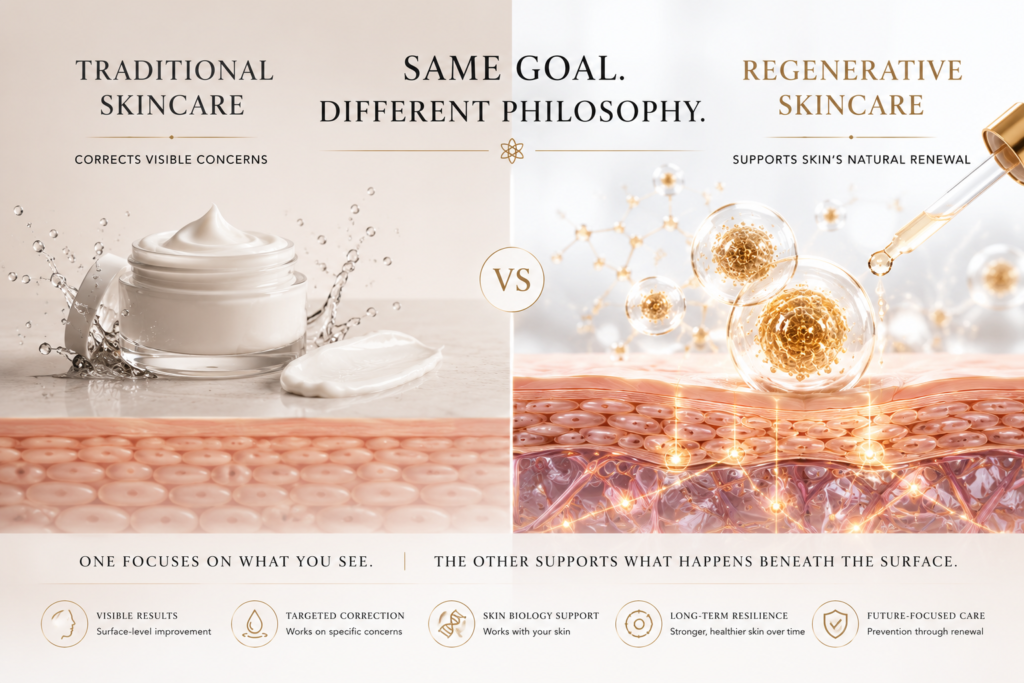
Regenerative actives — phyto-exosomes, bioactive peptides — support the skin’s own signalling and renewal processes. That support is meaningful only once there is an intact barrier to support. The wall first. The conversation after.
So finish the twelve weeks. Rebuild the wall with nothing but a cleanser, a moisturiser and a sunscreen. Then, if you want to think about skin longevity rather than damage control, we will be here — and your skin will finally be in a condition to make use of us.
Explore STEMGLOWTM — when your barrier is ready, not before.
4. FAQ — PEOPLE ALSO ASK
How long does a damaged skin barrier take to repair?
Stinging usually settles within a week and tightness within a month, but full recovery of tolerance typically takes eight to twelve weeks of consistent gentle care.
What are the signs of an over-exfoliated skin barrier?
Stinging on application of water or moisturiser, persistent redness, tightness alongside oiliness, new sensitivity, and skin that feels unusually thin or reactive.
Should I stop all actives to repair my skin barrier?
Yes. Pause retinoids, acids, scrubs and high-percentage vitamin C. Keep only a gentle cleanser, a ceramide moisturiser, and daily broad-spectrum sunscreen.
Can I use exosome or peptide serums on a damaged barrier?
It is better to wait. Active treatments support skin that has an intact barrier. Restore the barrier first, then reintroduce regenerative actives gradually.
When can I use retinol again after barrier damage?
Only after your skin has been calm for at least two consecutive weeks, and then at twice-weekly frequency, increasing slowly over several weeks.