


Phyto-Exosome vs Stem Cell Serum: What’s the Difference?
There are no living stem cells in your stem cell serum. There never were, and there is no formulation on earth in which there could be.
This is not an accusation. It is a fact of chemistry that the entire category has quietly agreed not to say out loud — and understanding why explains almost everything about what you are actually buying.
Start With What a Cell Needs
A living cell is not an ingredient. It is an organism with requirements.
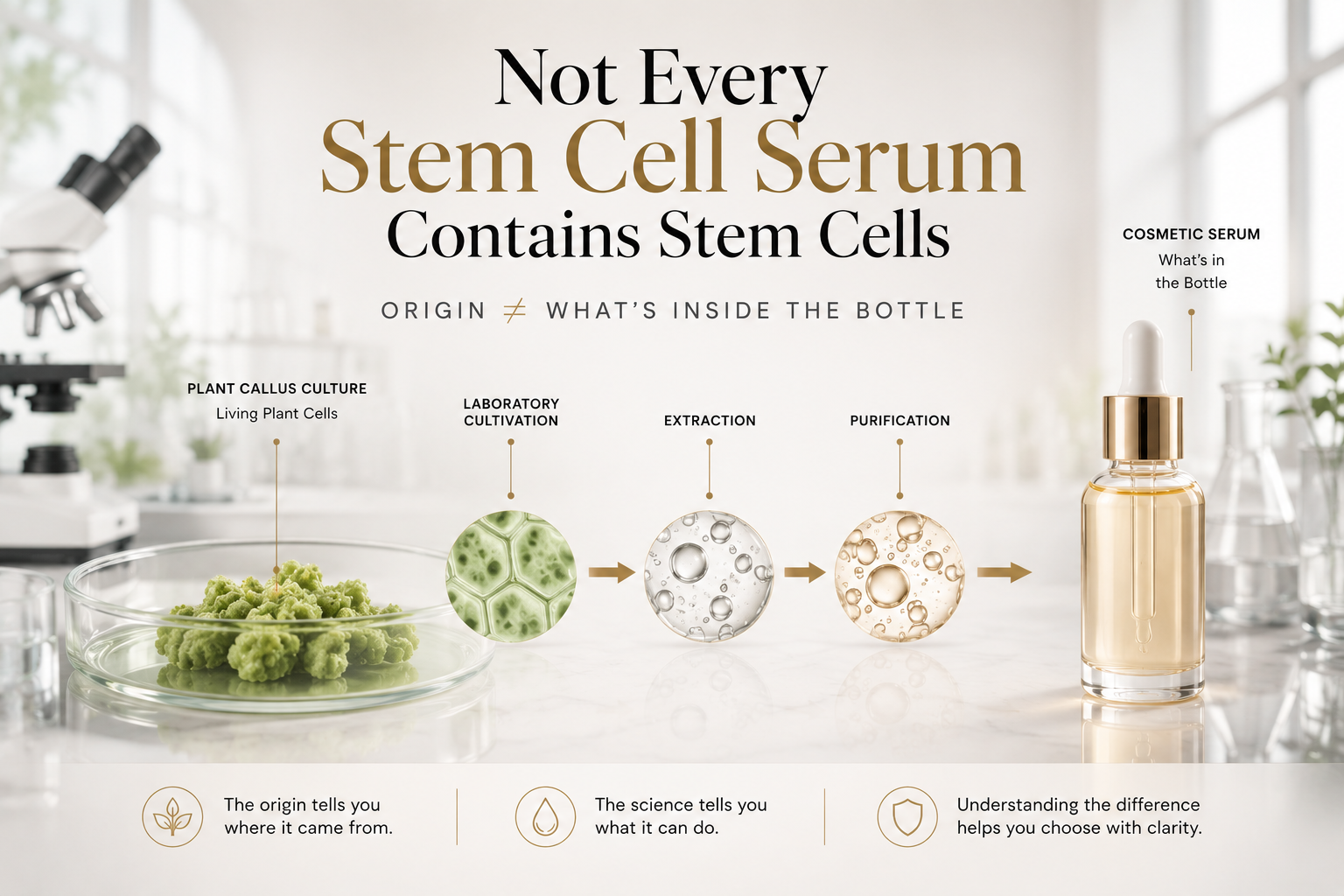
It needs a controlled temperature, a nutrient supply, an osmotic balance, and an environment free of antimicrobial agents. A cosmetic serum offers none of these. It offers, by regulatory necessity, a preservative system engineered specifically to make the bottle uninhabitable — because a serum in which cells could survive is a serum in which bacteria could survive.
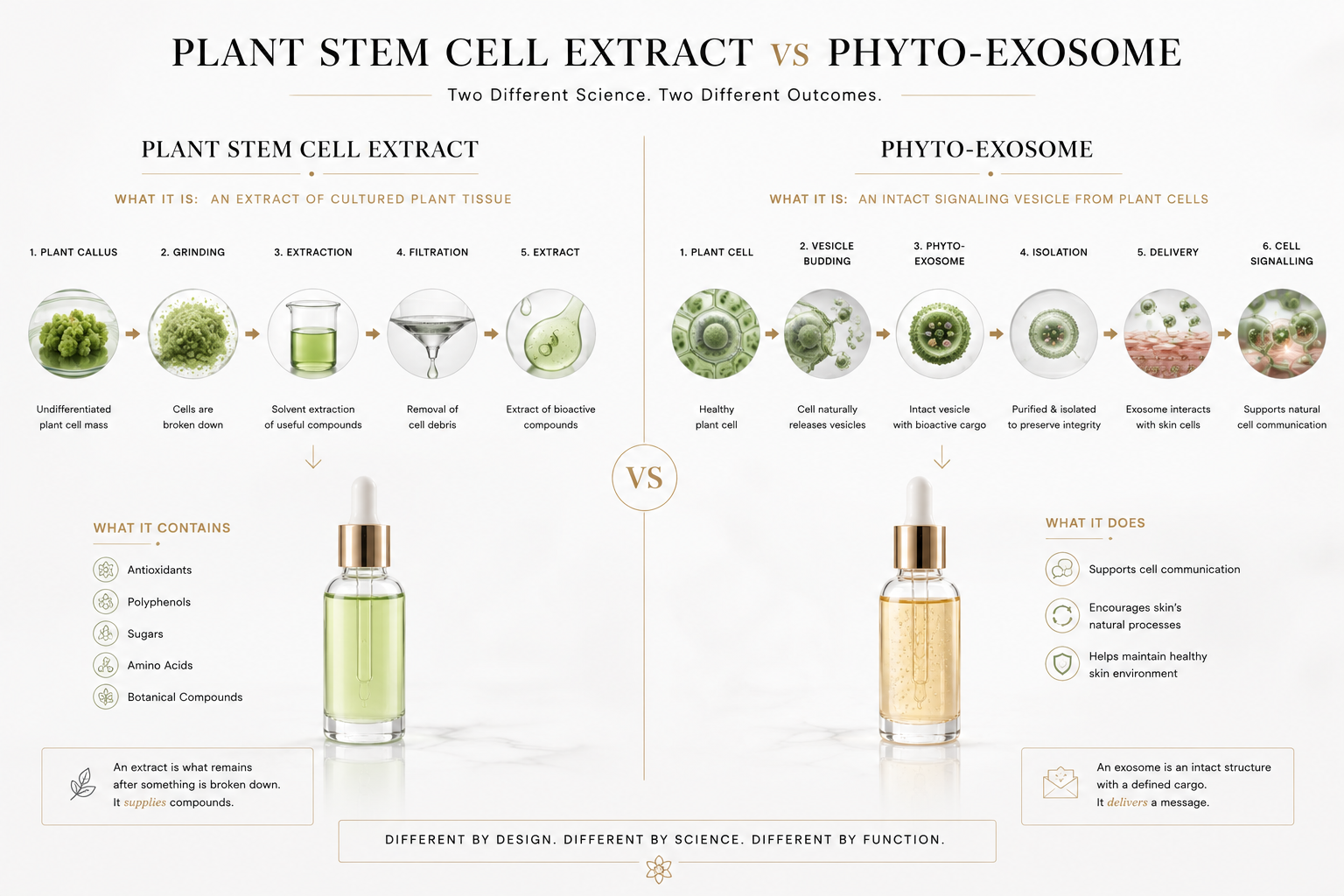
So when a label says “plant stem cell,” it is describing where the material came from, not what is in the bottle. The plant cells were cultured in a laboratory — typically as a callus, an undifferentiated mass of plant tissue — and then processed. What survives that processing is an extract: polyphenols, sugars, antioxidant compounds, structural fragments.
An extract can be genuinely useful. It is simply not a stem cell, in the same way that flour is not wheat.
What a Phyto-Exosome Actually Is
Now the harder idea, and the one worth the reading.
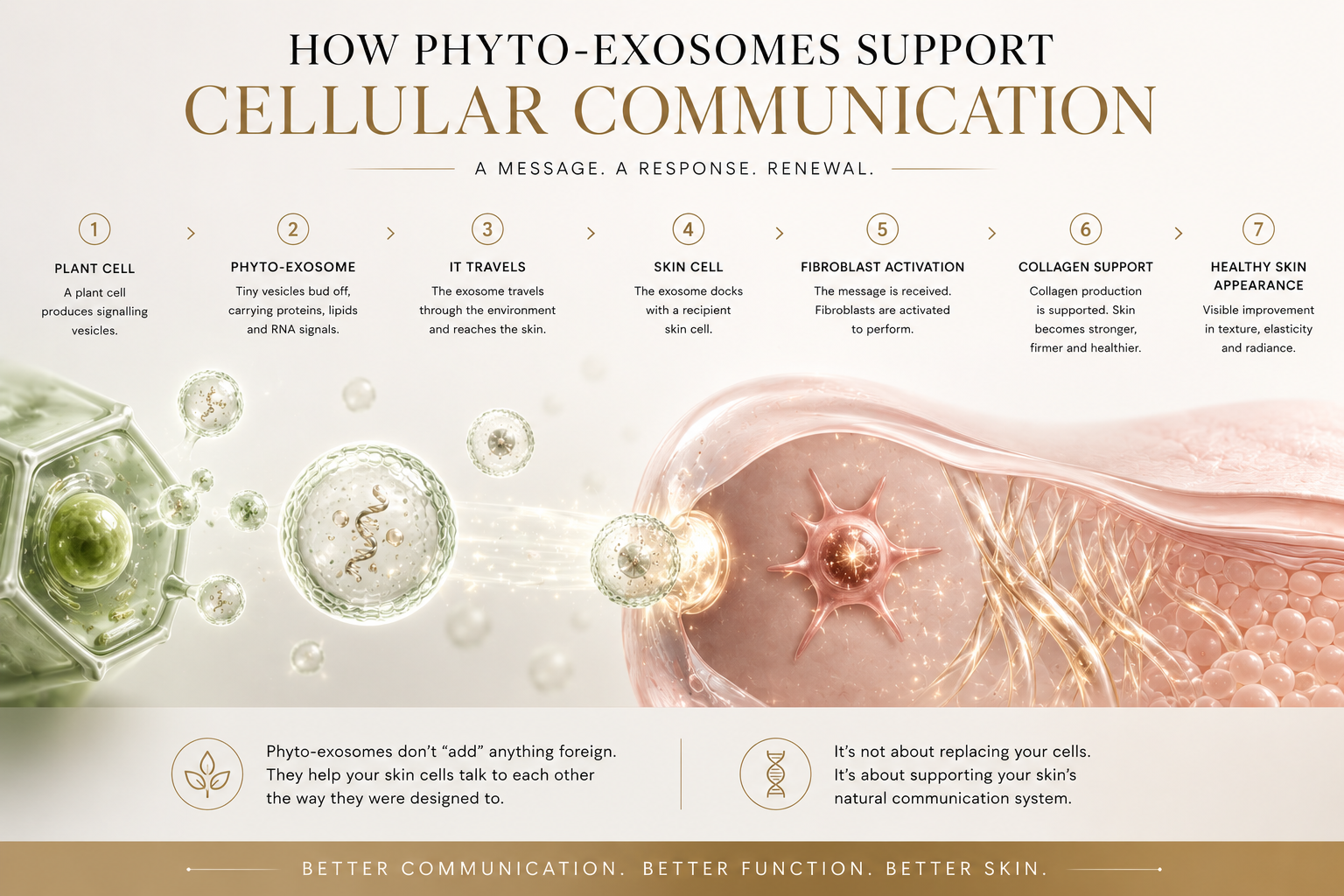
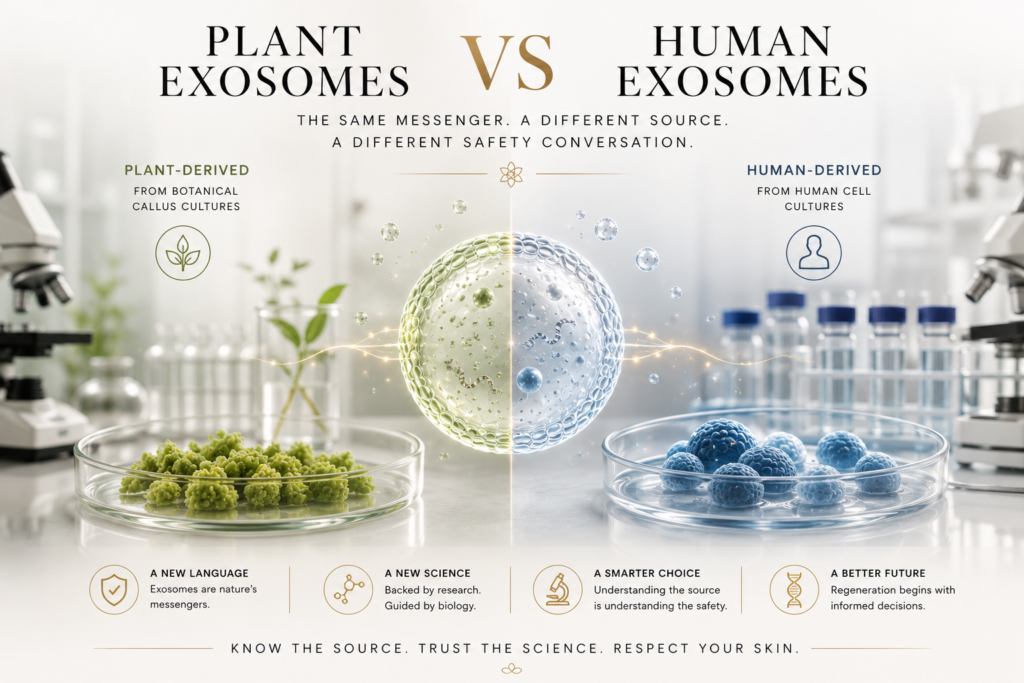
Cells do not work alone. They coordinate, constantly, by packaging molecular instructions — signalling proteins, lipids, small RNAs — inside a membrane-bound vesicle and releasing it. Another cell receives that vesicle and reads what it carries. This is cell signalling. It is the conversation that decides whether a fibroblast produces collagen today or does not.
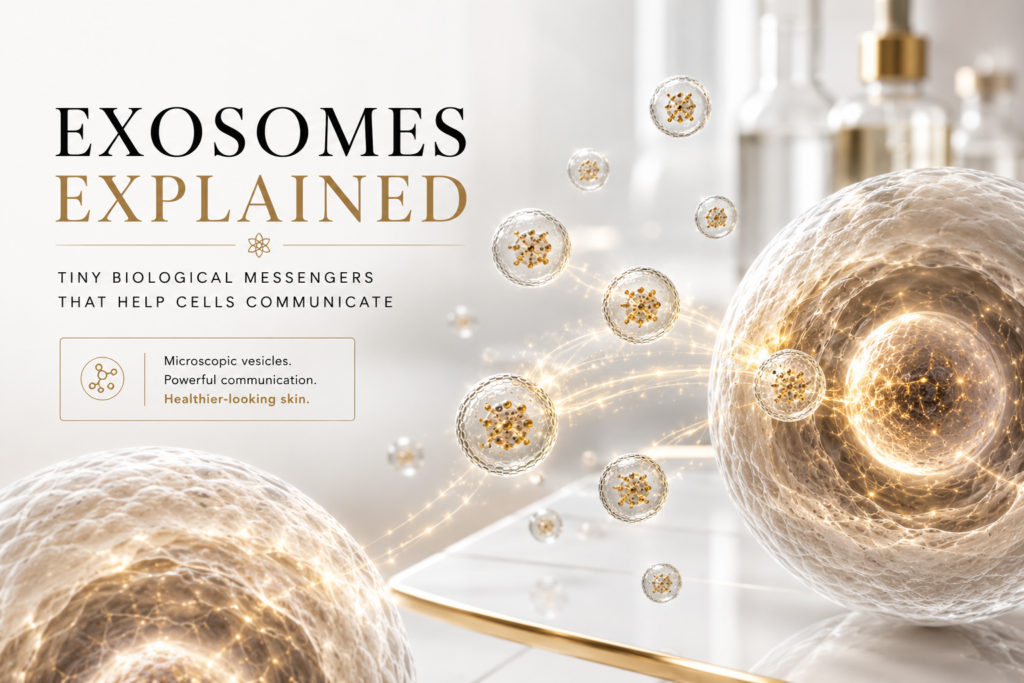
Exosomes are those vesicles. Phyto-exosomes are the ones plants make.
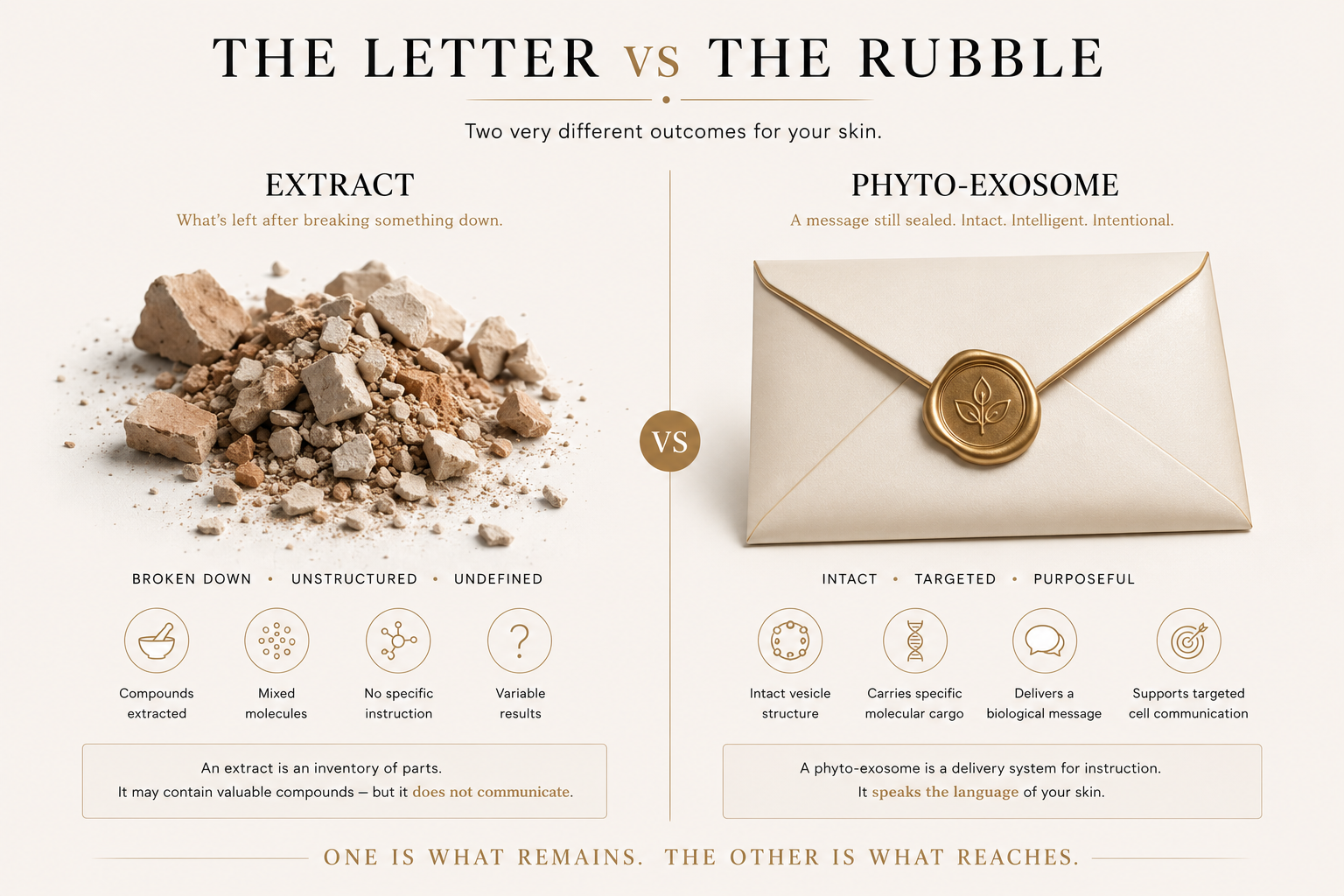
The distinction from an extract is architectural, not semantic. An extract is what remains after you break something down — an inventory of contents. An exosome is an intact structure with a defined cargo, isolated deliberately. One is rubble. The other is a letter, still sealed.
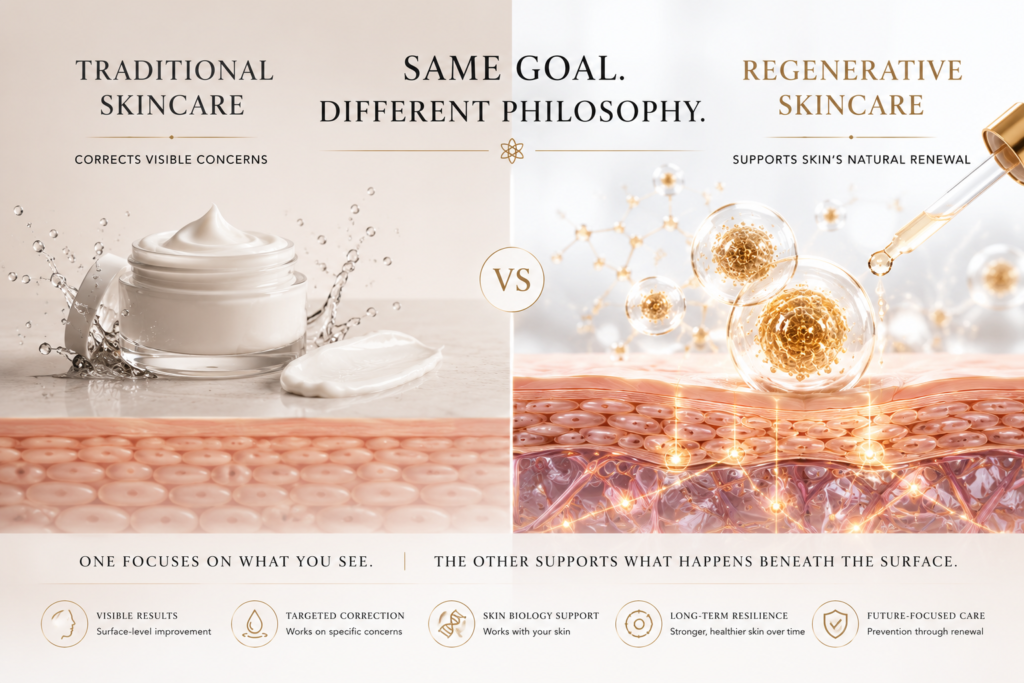
This is why the two behave differently in a formulation. An extract contributes compounds. A phyto-exosome participates in a signalling environment. Both may support the skin; they do so by different routes, and only one of them was designed to be read.
The Comparison, Honestly Drawn
“Stem Cell” Serum | Phyto-Exosome Serum | |
What is in the bottle | Plant callus extract — the remains of cultured plant tissue | Isolated signalling vesicles carrying molecular instructions |
Are there living cells? | No. Cells do not survive formulation | No, and none are claimed |
Mechanism | Antioxidant and protective compounds from the extract | Supports the skin’s own cell-signalling environment |
Standardisation | Extract composition varies by batch and method | Vesicles isolated to a defined specification |
What the name implies | More than the bottle contains | Exactly what the bottle contains |
Why the Wrong Word Survived
“Stem cell” entered cosmetics because it borrowed authority from regenerative medicine. The phrase carries the weight of clinical research that cosmetic formulations do not conduct and cannot claim.
Regulators in several markets have since grown uneasy, and in India the language sits in an unresolved space. A cosmetic ingredient described in terms that imply a biological therapy invites scrutiny it cannot survive — and consumers, increasingly, are arriving at the same conclusion faster than the regulators.
The category’s problem is not that plant extracts are ineffective. It is that the name promised a mechanism the bottle never contained, and the correction is now overdue.
DOCTOR'S NOTE
I am aware of the irony of what I am about to write. My brand is called STEMIOLOGY. The word sits on every bottle we make.
It refers to the science of regeneration — the study of how tissue renews itself. It does not mean there are stem cells in the serum, because there are not, and there could not be. No cosmetic serum on any shelf in India contains living stem cells. A cell requires nutrients, temperature control, and an environment a preservative system is specifically designed to make uninhabitable.
So when a patient brings me a “plant stem cell serum,” I do not tell them it is worthless. I tell them the name is describing a manufacturing origin, not a mechanism. What they are applying is a botanical extract. That may be perfectly good. It is simply not what the word promised — and a category that needs the wrong word to sell itself has not yet earned the right one.
— Dr. Samir
How to Tell Them Apart on a Label
Four checks, in order:
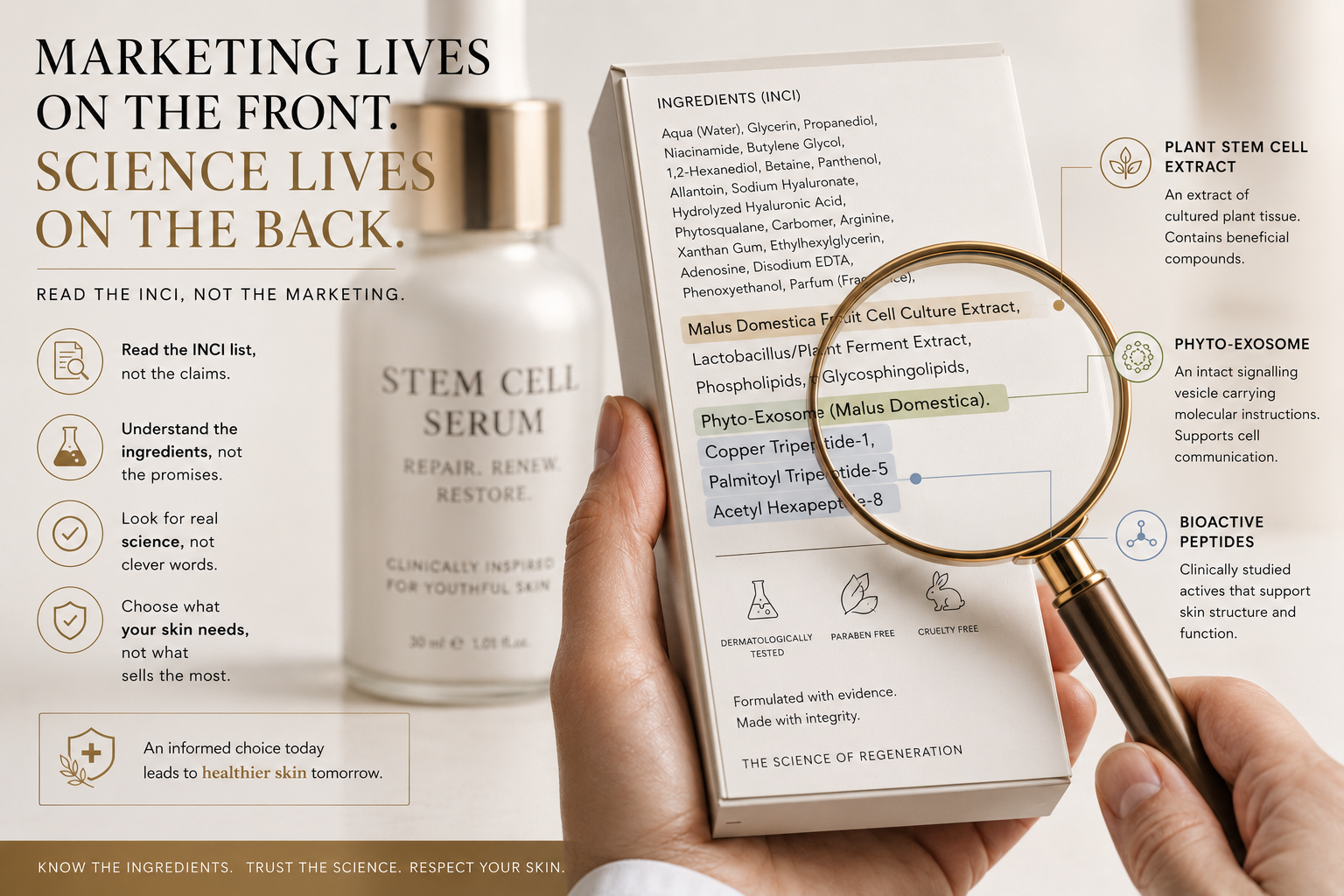
- Read the INCI, not the front. “Callus culture extract” or “cell culture extract” indicates an extract. An isolated exosome fraction is named as such.
- Ask what the vesicle carries. A brand selling phyto-exosomes should be able to describe the cargo. A brand that cannot is selling the word.
- Check whether it stands alone. A signalling vesicle arriving in a formulation with no bioactive peptides or antioxidants is a message delivered to an empty room.
- Watch the verbs. “Supports” and “helps improve” describe clinically studied ingredients honestly. “Regenerates,” “repairs,” “restores stem cells” describes a marketing department.
Which One Should You Choose?
If a plant extract suits your skin, use it. Antioxidant compounds are real, and this article is not an argument against them.
But if you are choosing on mechanism — if the reason you entered this category was the promise of participating in your skin’s own cellular conversation rather than merely supplying it with raw material — then the extract was never the thing you were looking for. The vesicle is.
Where STEMGLOW™ Sits
STEMGLOW™ is built on a plant-derived phyto-exosome core, paired with bioactive peptides and clinically studied actives so the signal arrives somewhere prepared to receive it. It is formulated in a GMP-certified facility. It contains no living cells, and we will never suggest otherwise.
Our name is STEMIOLOGY because we study regeneration. Not because we sell stem cells. In a category built on a borrowed word, saying so plainly is the most useful thing we can do.
Explore STEMGLOW™ — The Science of Regeneration.
4. FAQ — PEOPLE ALSO ASK
Do stem cell serums contain real stem cells?
No. Living cells cannot survive a cosmetic preservative system. A plant stem cell serum contains an extract derived from cultured plant tissue, not living cells.
What is the difference between a plant stem cell extract and a phyto-exosome?
An extract is the broken-down contents of cultured plant tissue. A phyto-exosome is an intact signalling vesicle isolated from it, carrying a defined molecular cargo.
Are phyto-exosomes better than plant stem cell extracts?
They work by different routes. Extracts supply antioxidant compounds; phyto-exosomes support the skin’s own cell-signalling environment. Neither is universally superior.
Is plant stem cell skincare safe?
Plant-derived extracts are widely used as cosmetic ingredients and are generally well tolerated. The concern with the category is labelling accuracy rather than safety.
Can a serum regenerate skin cells?
No topical formulation regenerates cells. Clinically studied ingredients support the conditions under which skin carries out its own renewal processes.